Eko: Digital Stethoscopes
- 4.9
- Rating
- 100.00K
- Installs
- Free
- Price

 Analysis by App-foxy
I approached Eko: Digital Stethoscopes as a practical medical app rather than a general wellness tool. Its purpose is closely tied to physical examination: it works with Eko’s digital stethoscope ecosystem to help turn a familiar clinical instrument into a more connected listening and review experience. That immediately makes it different from symptom checkers, appointment apps, medication reminders, and ordinary phone recording tools. The right question is not whether everyone needs it, but whether your work or training already involves auscultation and would benefit from a digital layer.
My overall impression is that this is a focused companion for clinicians, students, educators, and healthcare teams who want more from a stethoscope than a purely analog listening session. The app is free to install, carries an Everyone age rating, and is developed by Eko Health, Inc. It has reached over one hundred thousand installs and holds a 4.9 average from around five thousand ratings, which suggests strong satisfaction among the people who choose this kind of tool. That should not be mistaken for a reason to download it casually: the value depends heavily on compatible Eko hardware and on your clinical workflow.
What I would consider before choosing it
My first decision criterion would be equipment. This is not the kind of medical app that becomes useful simply because it is on a phone. Its role is to amplify and organize physical examination with Eko’s digital stethoscopes, so a person who does not use that hardware may find little practical value in the app itself. Before installing, I would ask whether I already have an Eko device, whether my workplace permits connected examination tools, and whether I actually need digital support during auscultation.
You May Also Like

 Blood Strike: 2.5 Anniversary
Blood Strike’s Loadouts Turn Every Drop Into a Tactical Gamble
A close look at Blood Strike’s custom loadouts: how fast access to signature weapons reshapes its battle royale rhythm, rewards preparation, and narrows the gap between fights.

 Pandora - Music & Podcasts
Pandora’s Music Is Easy to Start, but Harder to Recover
Pandora’s strength is its low-effort path from a seed to a station. Its weak spot is how much confidence it asks you to place in connection, setup, and quiet recovery.

 8 Ball Pool
 Is Built on Rivalries, Rematches, and Routine
A close look at the rivalries, rematches, shared routines, and unanswered safety questions that turn a quick pool match into a persistent mobile community.

 Samsung Music
’s Quiet Strength Is Playing What You Already Own
Its reach comes less from spectacle than from dependable access to a personal library. That simplicity is both the app’s strongest retention engine and its ceiling.

 AccuWeather: Weather Radar
AccuWeather Review: A Quick, Clear Forecast for Everyday Decisions
For everyday plans, the best forecast is the one you can understand quickly. AccuWeather makes rain timing, radar, and local conditions easy to act on, with a few trade-offs.

 Hill Climb Racing
Why Hill Climb Racing Still Turns Crashes Into One More Run
A tiny car, a bumpy hill and one more upgrade: Hill Climb Racing keeps resurfacing because its simple chaos makes every near-miss feel personal.
More From Our News Desk



The second criterion is the type of listening work you do. A student practicing heart or lung sounds may appreciate a more structured way to revisit what they heard. A clinician moving between patient rooms may care more about speed and minimal interruption. An educator may value the ability to make examination discussions more concrete. Those are different needs, even though they all involve a stethoscope, and the app is more convincing when it is part of a repeated routine rather than an occasional experiment.
I would also think about phone compatibility before making plans around it. The current version is 5.48.0 and requires at least iOS 12. That is a reasonable baseline for many users, but anyone working with an older device should check the operating system before purchasing or relying on related hardware. Compatibility is not a glamorous consideration, yet it is exactly the kind of detail that can derail a clinical workflow when an app is expected to work immediately.
Finally, I would separate the free download from the complete cost of ownership. The app itself is free, but in-app purchases are listed at $119.99 per item. That does not make the app automatically poor value, because professional equipment can justify a substantial investment when it solves a real problem. It does mean that I would not treat the free price as the final decision. The sensible comparison is between the whole Eko setup and the value of staying with an analog stethoscope, not between a free app and a paid app in isolation.
How it fits into an ordinary examination
Imagine a clinician preparing for a routine visit in a busy outpatient setting. The physical examination still begins in the usual way: positioning the patient, choosing the correct listening points, and paying attention to the sound rather than staring at a screen. The app becomes useful when the clinician wants the digital stethoscope to contribute more than sound transmission. The strongest workflow, in my view, is to keep the phone secondary during the examination and use it as a supporting surface before or after the hands-on part.
That distinction matters. A digital tool should not encourage someone to replace careful patient interaction with phone handling. I would set up the connection before entering the room, keep the clinical conversation central, and avoid making the patient feel as if the examination is being performed by an app. Used that way, the software can support the physical exam without turning it into a technology demonstration.
For a learner, the scenario changes slightly. A student might use the connected stethoscope during supervised practice, then revisit difficult findings with a mentor. The benefit is not simply hearing a louder signal. It is having a way to slow down the learning process and discuss why a sound was interpreted in a particular way. That can be especially helpful when several students hear the same examination differently, although the app cannot replace a qualified instructor or clinical judgment.
For a remote consultation, I would be more cautious. Digital transmission can be attractive when another professional needs to participate, but clinical usefulness depends on the complete setup, the communication method, and the quality of the examination context. I would never assume that an app designed to amplify a physical exam automatically makes remote diagnosis reliable. It can support a professional workflow; it should not be treated as an independent diagnostic authority.
Where Eko makes the strongest case
The clearest strength is its specialization. Unlike a general audio recorder, this app belongs to a purpose-built medical ecosystem. That focus matters because ordinary recording software knows nothing about the examination context. It may capture sound, but it does not provide the same sense of continuity between the instrument, the listening task, and the review process. Eko’s approach is more coherent for someone who already wants a digital stethoscope rather than a substitute assembled from unrelated tools.
I also see value in the way a digital workflow can make teaching more specific. Verbal descriptions of heart and lung sounds are difficult for beginners because terms such as murmur, crackle, or wheeze can remain abstract. When a learner and supervisor can discuss an actual captured listening experience, the conversation may become more concrete. The important advantage is not that the software magically identifies every finding; it is that it can give the learning discussion a shared reference point.
Another less obvious advantage is consistency. In a busy practice, the quality of an examination can be affected by background noise, rushed transitions, and differences in how people hold or position a traditional stethoscope. A digital system may help a clinician build a repeatable routine, particularly when the same tool is used across training and patient care. I would still treat technique as the main variable, but reducing avoidable friction can make a meaningful difference over time.
The app may also suit teams that want their examination habits to feel more modern without abandoning the physical exam. That is an important distinction. Some health technology tries to replace in-person assessment with forms, questionnaires, or automated predictions. Eko’s appeal is almost the opposite: it keeps the stethoscope at the center and adds digital support around it. For clinicians who believe the physical examination remains essential, that is a more natural transition than moving directly to a screen-first system.
The high user rating is encouraging, and the app has been available since February 2017, giving it a longer history than a newly launched medical companion. I would read that as evidence of sustained interest rather than proof that it suits every specialty or institution. Medical software is judged by fit, reliability, and workflow discipline, not just by a store score.
What may be better about the usual alternatives
An analog stethoscope remains the simplest alternative. It needs no app setup, no phone battery, and no digital connection. For a clinician who already hears clearly, works in environments where phones are inconvenient, or wants the fewest possible points of failure, analog may be the better choice. It is also easier to hand to another professional without explaining an ecosystem. Eko wins when digital review, teaching, or connected examination adds enough value to justify that extra layer.
A general recording app is another possible alternative, but I would choose it only for limited, non-clinical purposes and with careful attention to privacy and consent. It may be cheaper or already installed, yet it lacks the purpose-built relationship between a compatible stethoscope and medical listening. A generic recorder can appear flexible while leaving the user responsible for every part of the workflow. That is not necessarily a benefit in a clinical setting.
Dedicated medical education platforms may be stronger for learners who mainly want a library of examples, quizzes, or structured lessons. Eko is more compelling when the learner wants to connect study with live physical examination. If your priority is broad theory and repeated testing away from patients, an educational platform may offer a clearer path. If your priority is learning to listen during real examinations, the digital stethoscope approach is more directly relevant.
Hospital-grade examination systems or larger telemedicine solutions may fit institutions with complex documentation, integration, and governance requirements. I would not assume this app alone can replace those systems. Its appeal is its focused role, not an all-purpose enterprise platform. A small practice or individual professional may appreciate that focus, while a large organization may need a wider technical and administrative framework.
There is also a human alternative: a second trained set of ears. For difficult findings, direct consultation with a colleague can be more valuable than any app. Digital tools can support discussion, but they do not remove the need for experience, examination technique, or escalation when something is uncertain. I would consider Eko an aid to professional reasoning, not a substitute for it.
The practical cost of changing your routine
Switching from a traditional stethoscope to a connected workflow involves more than installing software. You need to learn where the app belongs in the examination, how much attention to give the phone, and when digital review is genuinely useful. That learning curve may be modest, but it is still a cost. If the tool is used only once every few months, the habit may never become smooth enough to justify the change.
There is also a training cost for colleagues. If one person uses the system and everyone else works analog, shared examinations can become less straightforward. A supervisor may need to understand how the digital workflow supports teaching, while a patient may need a simple explanation of why a phone is present. I would prepare a short, reassuring explanation and keep the device out of the spotlight unless it contributes directly to care.
Privacy and governance deserve deliberate attention. Medical audio can be sensitive, and any organization using a connected examination workflow should establish its own rules for consent, storage, access, and documentation. I would not record or share clinical material casually, and I would check institutional policy before using the app in a workplace. The fact that an app is medical does not remove the professional responsibilities surrounding patient information.
Battery and connectivity are practical concerns as well. A phone-based workflow introduces another device that must be charged and ready. Even if the examination itself remains familiar, a dead phone or an unexpected connection issue can create friction at the worst moment. My preferred approach would be to keep an analog backup available and avoid making the digital component the only way to complete an examination.
The listed purchase price also changes the switching calculation. A free installation lowers the barrier to exploring the software, but the $119.99 per-item in-app purchase means a serious evaluation should include the hardware and any related spending. I would first test whether the workflow solves a repeated problem, then decide whether the investment makes sense. Buying first and searching for a use afterward is the wrong order.
Small workflow choices that make a difference
One useful habit is to decide before an examination whether the digital feature is needed. If the goal is ordinary bedside assessment, I would not open the app automatically. If the goal is teaching, reviewing a challenging sound, or supporting a defined team process, I would prepare it in advance. This simple decision prevents the phone from becoming a distraction and keeps the technology subordinate to the clinical purpose.
I would also use it selectively rather than trying to digitize every encounter. A few well-chosen examinations can teach more than a large collection of poorly organized recordings. For learners, it is better to attach a clear question to each review—what did we hear, where was it heard, and what else should be checked—than to collect sound clips without context. The app is most valuable when it strengthens reasoning, not when it becomes a storage habit.
Another practical insight is to compare digital listening with the unaided examination instead of assuming the amplified version is automatically superior. If the two impressions differ, that difference should prompt a technique check and professional discussion. Amplification can make details easier to notice, but it can also make background noise or handling artifacts more noticeable. I would treat unexpected sounds as a reason to reassess the setup, not as an immediate clinical conclusion.
For teaching teams, I would establish a consistent vocabulary and review routine. The app can support a discussion, but the educational value comes from what the group does around it. Agreeing on when to pause, how to describe findings, and when to seek a second opinion makes the digital component far more useful than simply passing a phone around. This is where the product can become part of a thoughtful learning system rather than an isolated gadget.
Who should use it, and who should skip it
I would recommend exploring Eko to medical students in supervised training, practicing clinicians who already use compatible Eko hardware, educators who teach auscultation, and teams that have a clear reason to review or share examination experiences within approved processes. It is particularly attractive to people who feel that a traditional stethoscope gives them the basics but not enough support for teaching, consistency, or digital review.
I would be less enthusiastic for someone looking for a general health app, a self-diagnosis tool, or a way to listen to their own body without professional guidance. The medical category can make an app sound broadly useful, but this one is specialized. A casual user may install it and discover that the meaningful experience depends on equipment, technique, and a legitimate examination context.
I would also hesitate if your workplace prohibits phones during patient care, if your device cannot meet the operating-system requirement, or if your practice has no process for handling clinical recordings or connected tools. In those situations, an analog stethoscope or an institution-approved system may be safer and simpler. The best medical technology is the technology that fits the environment without creating new risks.
My recommendation after weighing the trade-offs
My recommendation is conditional but positive: if you already work with Eko digital stethoscope hardware and want a focused companion for physical examination, this is worth trying. The free app makes initial exploration easier, and the combination of a strong user rating, long availability, and a clearly defined medical purpose gives it credibility. I especially see value for supervised education and for clinicians who have a repeatable reason to review or amplify auscultation.
I would not recommend choosing it simply because it is free or because a 4.9 average looks impressive. The real purchase decision concerns the complete workflow, including compatible equipment, training time, privacy practices, and the possibility of keeping an analog backup. If those pieces do not fit, the app may add complexity without improving care.
In the end, Eko succeeds because it respects the physical examination instead of trying to replace it with a generic screen experience. Its best use is quiet and practical: prepare it properly, use it when it answers a real clinical or educational need, and return attention to the patient. For the right professional, that can be a meaningful upgrade. For everyone else, a conventional stethoscope or a different medical app may remain the more sensible choice.
FAQs for Eko: Digital Stethoscopes
01What is Eko: Digital Stethoscopes used for?
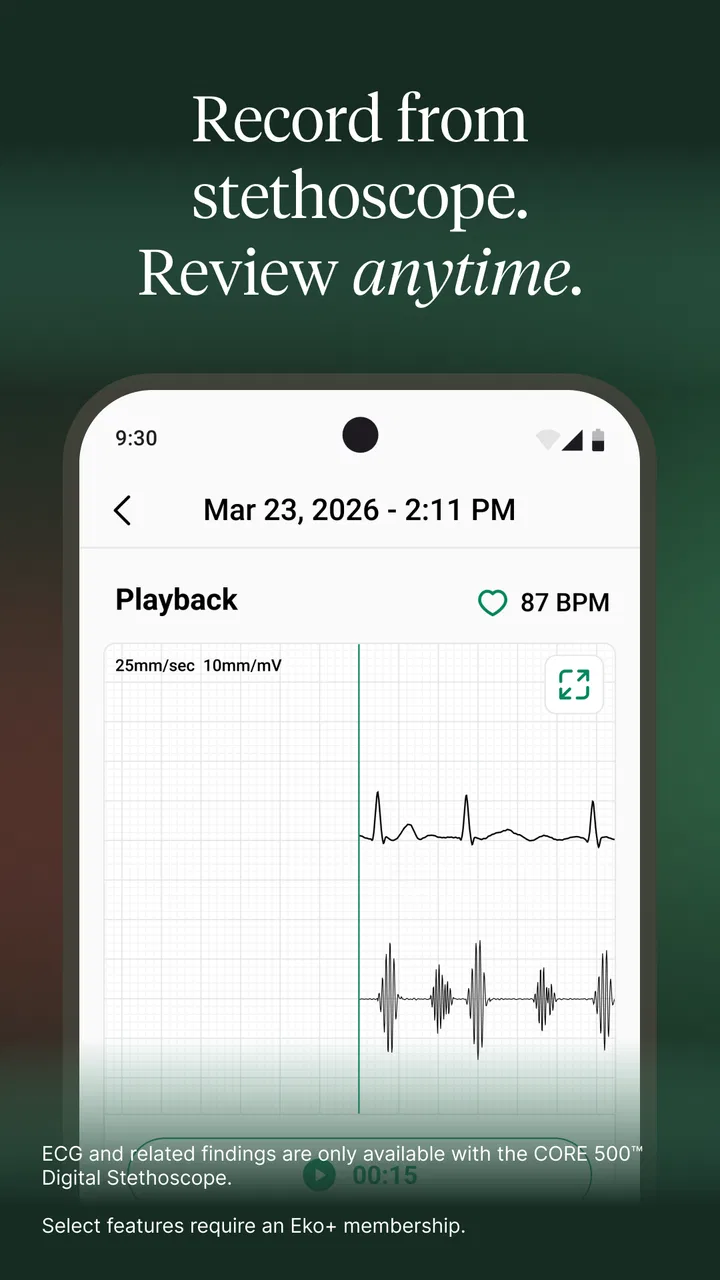
Eko: Digital Stethoscopes is a companion app for compatible Eko digital stethoscopes. It allows users to listen to, record, review, and organize heart and lung sounds captured through the connected device. Depending on the stethoscope model and available services, the app may also provide sound visualization, sharing tools, and analysis features intended to support clinical assessment and documentation.
02Is Eko: Digital Stethoscopes suitable for patients or only healthcare professionals?
The app is primarily designed for healthcare professionals and trained users who understand how to perform and interpret cardiopulmonary auscultation. It is not a general home-diagnosis tool, and recordings should not be used to confirm or rule out a medical condition without professional evaluation. Patients may use it when instructed by a clinician, but access and features can depend on the connected Eko device and account setup.
03Do I need an Eko digital stethoscope to use the app?
Yes, the main recording and listening functions generally require a compatible Eko digital stethoscope. The application is built to connect with supported Eko hardware through a mobile device, so installing it alone does not turn a phone into a medical stethoscope. Before downloading, check the current compatibility list, operating-system requirements, Bluetooth permissions, and whether your specific stethoscope model supports every advertised feature.
04Can Eko analyze heart or lung sounds and provide a diagnosis?
Eko may offer sound visualization, recording tools, and, on supported devices or plans, software-assisted analysis features. These tools are intended to help clinicians review auscultation data and should not be treated as an independent diagnosis. Results can be affected by placement, background noise, patient movement, and recording quality. Any alert or interpretation should be considered alongside symptoms, examination findings, and professional medical judgment.
05Are recordings in Eko: Digital Stethoscopes private and secure?
Because the app can handle health-related audio recordings and patient information, users should review Eko’s current privacy policy, consent requirements, storage options, and sharing controls before use. Avoid recording identifiable patient data unless your clinical setting permits it and appropriate consent has been obtained. Security may also depend on the phone, account, network, and organization’s policies, so keep the app updated and protect login access.
Pros
- Amplifies faint heart and lung sounds for easier clinical assessment.
- Digital recordings can be replayed and shared for consultation.
- Compact design is convenient for mobile visits and remote care.
- May help students compare real auscultation sounds during training.
- Works with compatible smartphones for a more portable setup.
Cons
- Requires compatible Eko hardware; the app alone cannot function as a stethoscope.
- Phone connectivity and pairing may take time in busy clinical settings.
- Recording and sharing patient audio raises privacy and consent concerns.
- Sound quality depends on the device
- placement
- and surrounding noise.
- Some advanced analysis features may require a paid subscription or plan.

Eko: Digital Stethoscopes
Gallery